“Master, my father has been anxious for me to accept an executive position with the Bengal-Nagpur Railway. But I have definitely refused it.” I added hopefully, “Sir, will you not make me a monk of the Swami Order?” I looked pleadingly at my guru. During preceding years, in order to test the depth of my determination, he had refused this same request. Today, however, he smiled graciously.
“Very well; tomorrow I will initiate you into swamiship.” He went on quietly, “I am happy that you have persisted in your desire to be a monk. Lahiri Mahasaya often said: ‘If you don’t invite God to be your summer Guest, He won’t come in the winter of your life.’”
“Dear master, I could never falter in my goal to belong to the Swami Order like your revered self.” I smiled at him with measureless affection.
“He that is unmarried careth for the things that belong to the Lord, how he may please the Lord: but he that is married careth for the things of the world, how he may please his wife.” 24-1 I had analyzed the lives of many of my friends who, after undergoing certain spiritual discipline, had then married. Launched on the sea of worldly responsibilities, they had forgotten their resolutions to meditate deeply.
To allot God a secondary place in life was, to me, inconceivable. Though He is the sole Owner of the cosmos, silently showering us with gifts from life to life, one thing yet remains which He does not own, and which each human heart is empowered to withhold or bestow-man’s love. The Creator, in taking infinite pains to shroud with mystery His presence in every atom of creation, could have had but one motive-a sensitive desire that men seek Him only through free will. With what velvet glove of every humility has He not covered the iron hand of omnipotence!
The following day was one of the most memorable in my life. It was a sunny Thursday, I remember, in July, 1914, a few weeks after my graduation from college. On the inner balcony of his Serampore hermitage, Master dipped a new piece of white silk into a dye of ocher, the traditional color of the Swami Order. After the cloth had dried, my guru draped it around me as a renunciate’s robe.
“Someday you will go to the West, where silk is preferred,” he said. “As a symbol, I have chosen for you this silk material instead of the customary cotton.”
In India, where monks embrace the ideal of poverty, a silk-clad swami is an unusual sight. Many yogis, however, wear garments of silk, which preserves certain subtle bodily currents better than cotton.
“I am averse to ceremonies,” Sri Yukteswar remarked. “I will make you a swami in the bidwat (non-ceremonious) manner.”
The bibidisa or elaborate initiation into swamiship includes a fire ceremony, during which symbolical funeral rites are performed. The physical body of the disciple is represented as dead, cremated in the flame of wisdom. The newly-made swami is then given a chant, such as: “This atma is Brahma” 24-2 or “Thou art That” or “I am He.” Sri Yukteswar, however, with his love of simplicity, dispensed with all formal rites and merely asked me to select a new name.
“I will give you the privilege of choosing it yourself,” he said, smiling.
“Yogananda,” I replied, after a moment’s thought. The name literally means “Bliss (ananda ) through divine union (yoga ).”
“Be it so. Forsaking your family name of Mukunda Lal Ghosh, henceforth you shall be called Yogananda of the Giri branch of the Swami Order.”
As I knelt before Sri Yukteswar, and for the first time heard him pronounce my new name, my heart overflowed with gratitude. How lovingly and tirelessly had he labored, that the boy Mukunda be someday transformed into the monk Yogananda! I joyfully sang a few verses from the long Sanskrit chant of Lord Shankara:
“Mind, nor intellect, nor ego, feeling; Sky nor earth nor metals am I. I am He, I am He, Blessed Spirit, I am He! No birth, no death, no caste have I; Father, mother, have I none. I am He, I am He, Blessed Spirit, I am He! Beyond the flights of fancy, formless am I, Permeating the limbs of all life; Bondage I do not fear; I am free, ever free, I am He, I am He, Blessed Spirit, I am He!”
Every swami belongs to the ancient monastic order which was organized in its present form by Shankara. 24-3 Because it is a formal order, with an unbroken line of saintly representatives serving as active leaders, no man can give himself the title of swami. He rightfully receives it only from another swami; all monks thus trace their spiritual lineage to one common guru, Lord Shankara. By vows of poverty, chastity, and obedience to the spiritual teacher, many Catholic Christian monastic orders resemble the Order of Swamis.
In addition to his new name, usually ending in ananda , the swami takes a title which indicates his formal connection with one of the ten subdivisions of the Swami Order. These dasanamis or ten agnomens include the Giri (mountain), to which Sri Yukteswar, and hence myself, belong. Among the other branches are the Sagar (sea), Bharati (land), Aranya (forest), Puri (tract), Tirtha (place of pilgrimage), and Saraswati (wisdom of nature).
The new name received by a swami thus has a twofold significance, and represents the attainment of supreme bliss (ananda ) through some divine quality or state-love, wisdom, devotion, service, yoga-and through a harmony with nature, as expressed in her infinite vastness of oceans, mountains, skies.
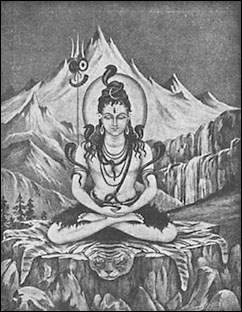
-by B. K. Mitra in “Kalyana-Kalpatur”
THE LORD IN HIS ASPECT AS SHIVA
Not a historical personage like Krishna, Shiva is the name given to God in the last aspect of His threefold nature (Creator-Preserver-Destroyer). Shiva, the Annihilator of maya or delusion, is symbolically represented in the scriptures as the Lord of Renunciates, the King of Yogis. In Hindu art He is always shown with the new moon in His hair, and wearing a garland of hooded snakes, ancient emblem of evil overcome and perfect wisdom. The “single” eye of omniscience is open on His forehead.
The ideal of selfless service to all mankind, and of renunciation of personal ties and ambitions, leads the majority of swamis to engage actively in humanitarian and educational work in India, or occasionally in foreign lands. Ignoring all prejudices of caste, creed, class, color, sex, or race, a swami follows the precepts of human brotherhood. His goal is absolute unity with Spirit. Imbuing his waking and sleeping consciousness with the thought, “I am He,” he roams contentedly, in the world but not of it. Thus only may he justify his title of swami-one who seeks to achieve union with the Swa or Self. It is needless to add that not all formally titled swamis are equally successful in reaching their high goal.
Sri Yukteswar was both a swami and a yogi. A swami, formally a monk by virtue of his connection with the ancient order, is not always a yogi. Anyone who practices a scientific technique of God-contact is a yogi; he may be either married or unmarried, either a worldly man or one of formal religious ties. A swami may conceivably follow only the path of dry reasoning, of cold renunciation; but a yogi engages himself in a definite, step-by-step procedure by which the body and mind are disciplined, and the soul liberated. Taking nothing for granted on emotional grounds, or by faith, a yogi practices a thoroughly tested series of exercises which were first mapped out by the early rishis. Yoga has produced, in every age of India, men who became truly free, truly Yogi-Christs.
Like any other science, yoga is applicable to people of every clime and time. The theory advanced by certain ignorant writers that yoga is “unsuitable for Westerners” is wholly false, and has lamentably prevented many sincere students from seeking its manifold blessings. Yoga is a method for restraining the natural turbulence of thoughts, which otherwise impartially prevent all men, of all lands, from glimpsing their true nature of Spirit. Yoga cannot know a barrier of East and West any more than does the healing and equitable light of the sun. So long as man possesses a mind with its restless thoughts, so long will there be a universal need for yoga or control.
The ancient rishi Patanjali defines “yoga” as “control of the fluctuations of the mind-stuff.” 24-4 His very short and masterly expositions, the Yoga Sutras , form one of the six systems of Hindu philosophy. 24-5 In contradistinction to Western philosophies, all six Hindu systems embody not only theoretical but practical teachings. In addition to every conceivable ontological inquiry, the six systems formulate six definite disciplines aimed at the permanent removal of suffering and the attainment of timeless bliss.
The common thread linking all six systems is the declaration that no true freedom for man is possible without knowledge of the ultimate Reality. The later Upanishads uphold the Yoga Sutras , among the six systems, as containing the most efficacious methods for achieving direct perception of truth. Through the practical techniques of yoga, man leaves behind forever the barren realms of speculation and cognizes in experience the veritable Essence.
The Yoga system as outlined by Patanjali is known as the Eightfold Path. The first steps, (1) yama and (2) niyama , require observance of ten negative and positive moralities-avoidance of injury to others, of untruthfulness, of stealing, of incontinence, of gift-receiving (which brings obligations); and purity of body and mind, contentment, self- discipline, study, and devotion to God.
The next steps are (3) asana (right posture); the spinal column must be held straight, and the body firm in a comfortable position for meditation; (4) pranayama (control of prana , subtle life currents); and (5) pratyahara (withdrawal of the senses from external objects).
The last steps are forms of yoga proper: (6) dharana (concentration); holding the mind to one thought; (7) dhyana (meditation), and (8) samadhi (superconscious perception). This is the Eightfold Path of Yoga 24-6 which leads one to the final goal of Kaivalya (Absoluteness), a term which might be more comprehensibly put as “realization of the Truth beyond all intellectual apprehension.”
“Which is greater,” one may ask, “a swami or a yogi?” If and when final oneness with God is achieved, the distinctions of the various paths disappear. The Bhagavad Gita, however, points out that the methods of yoga are all-embracive. Its techniques are not meant only for certain types and temperaments, such as those few who incline toward the monastic life; yoga requires no formal allegiance. Because the yogic science satisfies a universal need, it has a natural universal applicability.
A true yogi may remain dutifully in the world; there he is like butter on water, and not like the easily-diluted milk of unchurned and undisciplined humanity. To fulfill one’s earthly responsibilities is indeed the higher path, provided the yogi, maintaining a mental uninvolvement with egotistical desires, plays his part as a willing instrument of God.
There are a number of great souls, living in American or European or other non-Hindu bodies today who, though they may never have heard the words yogi and swami , are yet true exemplars of those terms. Through their disinterested service to mankind, or through their mastery over passions and thoughts, or through their single hearted love of God, or through their great powers of concentration, they are, in a sense, yogis; they have set themselves the goal of yoga-self-control. These men could rise to even greater heights if they were taught the definite science of yoga, which makes possible a more conscious direction of one’s mind and life.
Yoga has been superficially misunderstood by certain Western writers, but its critics have never been its practitioners. Among many thoughtful tributes to yoga may be mentioned one by Dr. C. G. Jung, the famous Swiss psychologist.
“When a religious method recommends itself as ‘scientific,’ it can be certain of its public in the West. Yoga fulfills this expectation,” Dr. Jung writes. 24-7 “Quite apart from the charm of the new, and the fascination of the half-understood, there is good cause for Yoga to have many adherents. It offers the possibility of controllable experience, and thus satisfies the scientific need of ‘facts,’ and besides this, by reason of its breadth and depth, its venerable age, its doctrine and method, which include every phase of life, it promises undreamed-of possibilities.
“Every religious or philosophical practice means a psychological discipline, that is, a method of mental hygiene. The manifold, purely bodily procedures of Yoga 24-8 also mean a physiological hygiene which is superior to ordinary gymnastics and breathing exercises, inasmuch as it is not merely mechanistic and scientific, but also philosophical; in its training of the parts of the body, it unites them with the whole of the spirit, as is quite clear, for instance, in the Pranayama exercises where Prana is both the breath and the universal dynamics of the cosmos.
“When the thing which the individual is doing is also a cosmic event, the effect experienced in the body (the innervation), unites with the emotion of the spirit (the universal idea), and out of this there develops a lively unity which no technique, however scientific, can produce. Yoga practice is unthinkable, and would also be ineffectual, without the concepts on which Yoga is based. It combines the bodily and the spiritual with each other in an extraordinarily complete way.
“In the East, where these ideas and practices have developed, and where for several thousand years an unbroken tradition has created the necessary spiritual foundations, Yoga is, as I can readily believe, the perfect and appropriate method of fusing body and mind together so that they form a unity which is scarcely to be questioned. This unity creates a psychological disposition which makes possible intuitions that transcend consciousness.”
The Western day is indeed nearing when the inner science of self- control will be found as necessary as the outer conquest of nature. This new Atomic Age will see men’s minds sobered and broadened by the now scientifically indisputable truth that matter is in reality a concentrate of energy. Finer forces of the human mind can and must liberate energies greater than those within stones and metals, lest the material atomic giant, newly unleashed, turn on the world in mindless destruction. 24-9
1-1: Oxford University Press, 1935.
1-2: Spiritual teacher; from Sanskrit root gur, to raise, to uplift.
1-3: A practitioner of yoga, “union,” ancient Indian science of meditation on God.
1-4: My name was changed to Yogananda when I entered the ancient monastic Swami Order in 1914. My guru bestowed the religious title of Paramhansa on me in 1935 (see chapters 24 and 42).
1-5: Traditionally, the second caste of warriors and rulers.
1-6: These ancient epics are the hoard of India’s history, mythology, and philosophy. An “Everyman’s Library” volume, Ramayana and Mahabharata, is a condensation in English verse by Romesh Dutt (New York: E. P. Dutton).
1-7: This noble Sanskrit poem, which occurs as part of the Mahabharata epic, is the Hindu Bible. The most poetical English translation is Edwin Arnold’s The Song Celestial (Philadelphia: David McKay, 75 cents). One of the best translations with detailed commentary is Sri Aurobindo’s Message Of The Gita (Jupiter Press, 16 Semudoss St., Madras, India, $3.50).
1-8: Babu (Mister) is placed in Bengali names at the end.
1-9: The phenomenal powers possessed by great masters are explained in chapter 30, “The Law of Miracles.”
1-10: A yogic technique whereby the sensory tumult is stilled, permitting man to achieve an ever-increasing identity with cosmic consciousness. (See chapter 26.)
1-11: A Sanskrit name for God as Ruler of the universe; from the root Is , to rule. There are 108 names for God in the Hindu scriptures, each one carrying a different shade of philosophical meaning.
1-12: The infinite potencies of sound derive from the Creative Word, Aum , the cosmic vibratory power behind all atomic energies. Any word spoken with clear realization and deep concentration has a materializing value. Loud or silent repetition of inspiring words has been found effective in Coueism and similar systems of psychotherapy; the secret lies in the stepping-up of the mind’s vibratory rate. The poet Tennyson has left us, in his Memoirs , an account of his repetitious device for passing beyond the conscious mind into superconsciousness:
“A kind of waking trance-this for lack of a better word-I have frequently had, quite up from boyhood, when I have been all alone,” Tennyson wrote. “This has come upon me through repeating my own name to myself silently, till all at once, as it were out of the intensity of the consciousness of individuality, individuality itself seemed to dissolve and fade away into boundless being, and this not a confused state but the clearest, the surest of the surest, utterly beyond words-where death was an almost laughable impossibility-the loss of personality (if so it were) seeming no extinction, but the only true life.” He wrote further: “It is no nebulous ecstasy, but a state of transcendent wonder, associated with absolute clearness of mind.”
1-13: Kali is a symbol of God in the aspect of eternal Mother Nature.
2-1: Sanskrit root meaning of swami is “he who is one with his Self (Swa).” Applied to a member of the Indian order of monks, the title has the formal respect of “the reverend.”
2-2: The Indian custom, whereby parents choose the life-partner for their child, has resisted the blunt assaults of time. The percentage is high of happy Indian marriages.
2-3: An anchorite; one who pursues a sadhana or path of spiritual discipline.
2-4: When I discovered by these words that Mother had possessed secret knowledge of a short life, I understood for the first time why she had been insistent on hastening the plans for Ananta’s marriage. Though she died before the wedding, her natural maternal wish had been to witness the rites.
2-5: A customary gesture of respect to sadhus .
3-1: Choto Mahasaya is the term by which a number of Indian saints addressed me. It translates “little sir.”.
3-2: In its own way, physical science is affirming the validity of laws discovered by yogis through mental science. For example, a demonstration that man has televisional powers was given on Nov. 26, 1934 at the Royal University of Rome. “Dr. Giuseppe Calligaris, professor of neuro-psychology, pressed certain points of a subject’s body and the subject responded with minute descriptions of other persons and objects on the opposite side of a wall. Dr. Calligaris told the other professors that if certain areas on the skin are agitated, the subject is given super-sensorial impressions enabling him to see objects that he could not otherwise perceive. To enable his subject to discern things on the other side of a wall, Professor Calligaris pressed on a spot to the right of the thorax for fifteen minutes. Dr. Calligaris said that if other spots of the body were agitated, the subjects could see objects at any distance, regardless of whether they had ever before seen those objects.”.
3-3: God in His aspect of Creator; from Sanskrit root brih , to expand. When Emerson’s poem Brahma appeared in the Atlantic Monthly in 1857, most the readers were bewildered. Emerson chuckled. “Tell them,” he said, “to say ‘Jehovah’ instead of ‘Brahma’ and they will not feel any perplexity.”
3-4: In deep meditation, the first experience of Spirit is on the altar of the spine, and then in the brain. The torrential bliss is overwhelming, but the yogi learns to control its outward manifestations.
3-5: After his retirement, Pranabananda wrote one of the most profound commentaries on the Bhagavad Gita, available in Bengali and Hindi.
4-1: Literally, “renunciate.” From Sanskrit verb roots, “to cast aside.”
4-2: Effects of past actions, in this or a former life; from Sanskrit kri, “to do.”
4-3: Bhagavad Gita, IX, 30-31. Krishna was the greatest prophet of India; Arjuna was his foremost disciple.
4-4: I always addressed him as Ananta-da. Da is a respectful suffix which the eldest brother in an Indian family receives from junior brothers and sisters.
4-5: At the time of our meeting, Kebalananda had not yet joined the Swami Order and was generally called “Shastri Mahasaya.” To avoid confusion with the name of Lahiri Mahasaya and of Master Mahasaya (chapter 9), I am referring to my Sanskrit tutor only by his later monastic name of Swami Kebalananda. His biography has been recently published in Bengali. Born in the Khulna district of Bengal in 1863, Kebalananda gave up his body in Benares at the age of sixty-eight. His family name was Ashutosh Chatterji.
4-6: The ancient four Vedas comprise over 100 extant canonical books. Emerson paid the following tribute in his Journal to Vedic thought: “It is sublime as heat and night and a breathless ocean. It contains every religious sentiment, all the grand ethics which visit in turn each noble poetic mind. . . . It is of no use to put away the book; if I trust myself in the woods or in a boat upon the pond, Nature makes a Brahmin of me presently: eternal necessity, eternal compensation, unfathomable power, unbroken silence. . . . This is her creed. Peace, she saith to me, and purity and absolute abandonment- these panaceas expiate all sin and bring you to the beatitude of the Eight Gods.”
4-7: The seat of the “single” or spiritual eye. At death the consciousness of man is usually drawn to this holy spot, accounting for the upraised eyes found in the dead.
4-8: The central sacred figure of the Sanskrit epic, Ramayana.
4-9: Ahankara, egoism; literally, “I do.” The root cause of dualism or illusion of maya, whereby the subject (ego) appears as object; the creatures imagine themselves to be creators.
5-1: Kali represents the eternal principle in nature. She is traditionally pictured as a four-armed woman, standing on the form of the God Shiva or the Infinite, because nature or the phenomenal world is rooted in the Noumenon. The four arms symbolize cardinal attributes, two beneficent, two destructive, indicating the essential duality of matter or creation.
5-2: Cosmic illusion; literally, “the measurer.” maya is the magical power in creation by which limitations and divisions are apparently present in the Immeasurable and Inseparable. Emerson wrote the following poem, to which he gave the title of maya:
Illusion works impenetrable, Weaving webs innumerable, Her gay pictures never fail, Crowd each other, veil on veil, Charmer who will be believed By man who thirsts to be deceived.
5-3: The rishis, literally “seers,” were the authors of the Vedas in an indeterminable antiquity..
5-4: Flat, round Indian bread..
5-5: Laymen scarcely realize the vast strides of twentieth-century science. Transmutation of metals and other alchemical dreams are seeing fulfillment every day in centers of scientific research over the world. The eminent French chemist, M. Georges Claude, performed “miracles” at Fontainebleau in 1928 before a scientific assemblage through his chemical knowledge of oxygen transformations. His “magician’s wand” was simple oxygen, bubbling in a tube on a table. The scientist “turned a handful of sand into precious stones, iron into a state resembling melted chocolate and, after depriving flowers of their tints, turned them into the consistency of glass.
“M. Claude explained how the sea could be turned by oxygen transformations into many millions of pounds of horsepower; how water which boils is not necessarily burning; how little mounds of sand, by a single whiff of the oxygen blowpipe, could be changed into sapphires, rubies, and topazes; and he predicted the time when it will be possible for men to walk on the bottom of the ocean minus the diver’s equipment. Finally the scientist amazed his onlookers by turning their faces black by taking the red out of the sun’s rays.”
This noted French scientist has produced liquid air by an expansion method in which he has been able to separate the various gases of the air, and has discovered various means of mechanical utilization of differences of temperature in sea water.
6-1: Sohong was his monastic name. He was popularly known as the “Tiger Swami.”
6-2: “Prince Princess”-so named to indicate that this beast possessed the combined ferocity of tiger and tigress.
7-1: Methods of controlling life-force through regulation of breath.
7-2: The foremost ancient exponent of yoga.
7-3: French professors were the first in the West to be willing to scientifically investigate the possibilities of the superconscious mind. Professor Jules-Bois, member of the L’Ecole de Psychologie of the Sorbonne, lectured in America in 1928; he told his audiences that French scientists have accorded recognition to the superconsciousness, “which is the exact opposite of Freud’s subconscious mind and is the faculty which makes man really man and not just a super-animal.” M. Jules-Bois explained that the awakening of the higher consciousness “was not to be confused with Coueism or hypnotism. The existence of a superconscious mind has long been recognized philosophically, being in reality the Oversoul spoken of by Emerson, but only recently has it been recognized scientifically.” The French scientist pointed out that from the superconsciousness come inspiration, genius, moral values. “Belief in this is not mysticism though it recognized and valued the qualities which mystics preached.”
7-4: St. Theresa of Avila and other Christian saints were often observed in a state of levitation.
7-5: “Great sage.”
7-6: Actual perception of God.
7-7: The saint’s full name was Nagendranath Bhaduri. Math means hermitage or ashram.
8-1: “All science is transcendental or else passes away. Botany is now acquiring the right theory-the avatars of Brahma will presently be the textbooks of natural history.”-Emerson.
8-2: From the Latin root, crescere, to increase. For his crescograph and other inventions, Bose was knighted in 1917.
8-3: The lotus flower is an ancient divine symbol in India; its unfolding petals suggest the expansion of the soul; the growth of its pure beauty from the mud of its origin holds a benign spiritual promise.
8-4: “At present, only the sheerest accident brings India into the purview of the American college student. Eight universities (Harvard, Yale, Columbia, Princeton, Johns Hopkins, Pennsylvania, Chicago, and California) have chairs of Indology or Sanskrit, but India is virtually unrepresented in departments of history, philosophy, fine arts, political science, sociology, or any of the other departments of intellectual experience in which, as we have seen, India has made great contributions. . . . We believe, consequently, that no department of study, particularly in the humanities, in any major university can be fully equipped without a properly trained specialist in the Indic phases of its discipline. We believe, too, that every college which aims to prepare its graduates for intelligent work in the world which is to be theirs to live in, must have on its staff a scholar competent in the civilization of India.”-Extracts from an article by Professor W. Norman Brown of the University of Pennsylvania which appeared in the May, 1939, issue of the Bulletin of the American Council of Learned Societies, 907 15th St., Washington, D. C., 25 cents copy. This issue (#28) contains over 100 pages of a “Basic Bibliography for Indic Studies.”
8-5: The atomic structure of matter was well-known to the ancient Hindus. One of the six systems of Indian philosophy is Vaisesika, from the Sanskrit root visesas, “atomic individuality.” One of the foremost Vaisesika expounders was Aulukya, also called Kanada, “the atom- eater,” born about 2800 years ago.
In an article in East-West, April, 1934, a summary of Vaisesika scientific knowledge was given as follows: “Though the modern ‘atomic theory’ is generally considered a new advance of science, it was brilliantly expounded long ago by Kanada, ‘the atom-eater.’ The Sanskrit anus can be properly translated as ‘atom’ in the latter’s literal Greek sense of ‘uncut’ or indivisible. Other scientific expositions of Vaisesika treatises of the B.C. era include (1) the movement of needles toward magnets, (2) the circulation of water in plants, (3) akash or ether, inert and structureless, as a basis for transmitting subtle forces, (4) the solar fire as the cause of all other forms of heat, (5) heat as the cause of molecular change, (6) the law of gravitation as caused by the quality that inheres in earth- atoms to give them their attractive power or downward pull, (7) the kinetic nature of all energy; causation as always rooted in an expenditure of energy or a redistribution of motion, (8) universal dissolution through the disintegration of atoms, (9) the radiation of heat and light rays, infinitely small particles, darting forth in all directions with inconceivable speed (the modern ‘cosmic rays’ theory), (10) the relativity of time and space.
“Vaisesika assigned the origin of the world to atoms, eternal in their nature, i.e., their ultimate peculiarities. These atoms were regarded as possessing an incessant vibratory motion. . . . The recent discovery that an atom is a miniature solar system would be no news to the old Vaisesika philosophers, who also reduced time to its furthest mathematical concept by describing the smallest unit of time (kala) as the period taken by an atom to traverse its own unit of space.”
8-6: Translated from the Bengali of Rabindranath Tagore, by Manmohan Ghosh, in Viswa-Bharati.
9-1: These are respectful titles by which he was customarily addressed. His name was Mahendra Nath Gupta; he signed his literary works simply “M.”
9-2: The Oxford English Dictionary gives, as rare, this definition of bioscope: A view of life; that which gives such a view.
Master Mahasaya’s choice of a word was, then, peculiarly justified.
10-1: Sanskrita, polished; complete. Sanskrit is the eldest sister of all Indo-European tongues. Its alphabetical script is Devanagari, literally “divine abode.” “Who knows my grammar knows God!” Panini, great philologist of ancient India, paid this tribute to the mathematical and psychological perfection in Sanskrit. He who would track language to its lair must indeed end as omniscient.
10-2: He was not Jatinda (Jotin Ghosh), who will be remembered for his timely aversion to tigers!
10-3: Path or preliminary road to God.
10-4: Hindu scriptures teach that family attachment is delusive if it prevents the devotee from seeking the Giver of all boons, including the one of loving relatives, not to mention life itself. Jesus similarly taught: “Who is my mother? and who are my brethren?” (Matthew 12:48.)
10-5: Ji is a customary respectful suffix, particularly used in direct address; thus “swamiji,” “guruji,” “Sri Yukteswarji,” “paramhansaji.”
10-6: Pertaining to the shastras, literally, “sacred books,” comprising four classes of scripture: the shruti, smriti, purana, and tantra. These comprehensive treatises cover every aspect of religious and social life, and the fields of law, medicine, architecture, art, etc. The shrutis are the “directly heard” or “revealed” scriptures, the Vedas. The smritis or “remembered” lore was finally written down in a remote past as the world’s longest epic poems, the Mahabharata and the Ramayana. Puranas are literally “ancient” allegories; tantras literally mean “rites” or “rituals”; these treatises convey profound truths under a veil of detailed symbolism.
10-7: “Divine teacher,” the customary Sanskrit term for one’s spiritual preceptor. I have rendered it in English as simply “Master.”
11-1: See chapter 25.
11-2: The world-famous mausoleum..
11-3: A dhoti-cloth is knotted around the waist and covers the legs..
11-4: Brindaban, in the Muttra district of United Provinces, is the Hindu Jerusalem. Here Lord Krishna displayed his glories for the benefit of mankind..
11-5: Hari; an endearing name by which Lord Krishna is known to his devotees.
11-6: An Indian sweetmeat..
11-7: A mythological gem with power to grant desires.
11-8: Spiritual initiation; from the Sanskrit root diksh, to dedicate oneself.
12-1: “Worship of Durga.” This is the chief festival of the Bengali year and lasts for nine days around the end of September. Immediately following is the ten-day festival of Dashahara (“the One who removes ten sins”-three of body, three of mind, four of speech). Both pujas are sacred to Durga, literally “the Inaccessible,” an aspect of Divine Mother, Shakti, the female creative force personified.
12-2: Sri Yukteswar was born on May 10, 1855.
12-3: Yukteswar means “united to God.” Giri is a classificatory distinction of one of the ten ancient Swami branches. Sri means “holy”; it is not a name but a title of respect.
12-4: Literally, “to direct together.” Samadhi is a superconscious state of ecstasy in which the yogi perceives the identity of soul and Spirit.
12-5: Snoring, according to physiologists, is an indication of utter relaxation (to the oblivious practitioner, solely).
12-6: Dhal is a thick soup made from split peas or other pulses. Channa is a cheese of fresh curdled milk, cut into squares and curried with potatoes.
12-7: The omnipresent powers of a yogi, whereby he sees, hears, tastes, smells, and feels his oneness in creation without the use of sensory organs, have been described as follows in the Taittiriya Aranyaka: “The blind man pierced the pearl; the fingerless put a thread into it; the neckless wore it; and the tongueless praised it.”
12-8: The cobra swiftly strikes at any moving object within its range. Complete immobility is usually one’s sole hope of safety.
12-9: Lahiri Mahasaya actually said “Priya” (first or given name), not “Yukteswar” (monastic name, not received by my guru during Lahiri Mahasaya’s lifetime). (See page 109.) “Yukteswar” is substituted here, and in a few other places in this book, in order to avoid the confusion, to reader, of two names.
12-10: “Therefore I say unto you, What things soever ye desire, when ye pray, believe that ye receive them, and ye shall have them.”-Mark 11:24. Masters who possess the Divine Vision are fully able to transfer their realizations to advanced disciples, as Lahiri Mahasaya did for Sri Yukteswar on this occasion.
12-11: “And one of them smote the servant of the high priest, and cut off his right ear. And Jesus answered and said, Suffer ye thus far. And he touched his ear and healed him.”-Luke 22:50-51.
12-12: “Give not that which is holy unto the dogs, neither cast ye your pearls before swine, lest they trample them under their feet, and turn again and rend you.”-Matthew 7:6.
12-13: Disciples; from Sanskrit verb root, “to serve.”
12-14: He was once ill in Kashmir, when I was absent from him. (See chapter 23.)
12-15: A courageous medical man, Charles Robert Richet, awarded the Nobel Prize in physiology, wrote as follows: “Metaphysics is not yet officially a science, recognized as such. But it is going to be. . . . At Edinburgh, I was able to affirm before 100 physiologists that our five senses are not our only means of knowledge and that a fragment of reality sometimes reaches the intelligence in other ways. . . . Because a fact is rare is no reason that it does not exist. Because a study is difficult, is that a reason for not understanding it? . . . Those who have railed at metaphysics as an occult science will be as ashamed of themselves as those who railed at chemistry on the ground that pursuit of the philosopher’s stone was illusory. . . . In the matter of principles there are only those of Lavoisier, Claude Bernard, and Pasteur-the experimental everywhere and always. Greetings, then, to the new science which is going to change the orientation of human thought.“
12-16: Samadhi : perfect union of the individualized soul with the Infinite Spirit.
12-17: The subconsciously guided rationalizations of the mind are utterly different from the infallible guidance of truth which issues from the superconsciousness. Led by French scientists of the Sorbonne, Western thinkers are beginning to investigate the possibility of divine perception in man.
“For the past twenty years, students of psychology, influenced by Freud, gave all their time to searching the subconscious realms,” Rabbi Israel H. Levinthal pointed out in 1929. “It is true that the subconscious reveals much of the mystery that can explain human actions, but not all of our actions. It can explain the abnormal, but not deeds that are above the normal. The latest psychology, sponsored by the French schools, has discovered a new region in man, which it terms the superconscious. In contrast to the subconscious which represents the submerged currents of our nature, it reveals the heights to which our nature can reach. Man represents a triple, not a double, personality; our conscious and subconscious being is crowned by a superconsciousness. Many years ago the English psychologist, F. W. H. Myers, suggested that ‘hidden in the deep of our being is a rubbish heap as well as a treasure house.’ In contrast to the psychology that centers all its researches on the subconscious in man’s nature, this new psychology of the superconscious focuses its attention upon the treasure-house, the region that alone can explain the great, unselfish, heroic deeds of men.”
12-18: Jnana , wisdom, and bhakti , devotion: two of the main paths to God.
12-19: “Man in his waking state puts forth innumerable efforts for experiencing sensual pleasures; when the entire group of sensory organs is fatigued, he forgets even the pleasure on hand and goes to sleep in order to enjoy rest in the soul, his own nature,” Shankara, the great Vedantist, has written. “Ultra-sensual bliss is thus extremely easy of attainment and is far superior to sense delights which always end in disgust.”
12-20: Mark 2:27.
12-21: The Upanishads or Vedanta (literally, “end of the Vedas”), occur in certain parts of the Vedas as essential summaries. The Upanishads furnish the doctrinal basis of the Hindu religion. They received the following tribute from Schopenhauer: “How entirely does the Upanishad breathe throughout the holy spirit of the Vedas ! How is everyone who has become familiar with that incomparable book stirred by that spirit to the very depths of his soul! From every sentence deep, original, and sublime thoughts arise, and the whole is pervaded by a high and holy and earnest spirit. . . . The access to the Vedas by means of the Upanishads is in my eyes the greatest privilege this century may claim before all previous centuries.”
12-22: Commentaries. Shankara peerlessly expounded the Upanishads .
12-23: Proverbs 16:32.
13-1: Hand-played drums, used only for devotional music.
13-2: One is reminded here of Dostoevski’s observation: “A man who bows down to nothing can never bear the burden of himself.”
13-3: See chapter 35.
14-1: “In the beginning was the Word, and the Word was with God, and the Word was God.”-John 1:1.
14-2: “For the Father judgeth no man, but hath committed all judgment unto the Son.”-John 5:22. “No man hath seen God at any time; the only begotten Son, which is in the bosom of the Father, he hath declared him.”-John 1:18. “Verily, verily, I say unto you, he that believeth on me, the works that I do shall he do also; and greater works than these shall he do; because I go unto my Father.”-John 14:12. “But the Comforter, which is the Holy Ghost, whom the Father will send in my name, he shall teach you all things, and bring all things to your remembrance, whatsoever I have said to you.”-John 14:26.
These Biblical words refer to the threefold nature of God as Father, Son, Holy Ghost (Sat , Tat , Aum in the Hindu scriptures). God the Father is the Absolute, Unmanifested, existing beyond vibratory creation. God the Son is the Christ Consciousness (Brahma or Kutastha Chaitanya ) existing within vibratory creation; this Christ Consciousness is the “only begotten” or sole reflection of the Uncreated Infinite. Its outward manifestation or “witness” is Aum or Holy Ghost, the divine, creative, invisible power which structures all creation through vibration. Aum the blissful Comforter is heard in meditation and reveals to the devotee the ultimate Truth.
15-1: Puri, about 310 miles south of Calcutta, is a famous pilgrimage city for devotees of Krishna; his worship is celebrated there with two immense annual festivals, Snanayatra and Rathayatra .
15-2: The 1939 discovery of a radio microscope revealed a new world of hitherto unknown rays. “Man himself as well as all kinds of supposedly inert matter constantly emits the rays that this instrument ‘sees,’” reported the Associated Press . “Those who believe in telepathy, second sight, and clairvoyance, have in this announcement the first scientific proof of the existence of invisible rays which really travel from one person to another. The radio device actually is a radio frequency spectroscope. It does the same thing for cool, nonglowing matter that the spectroscope does when it discloses the kinds of atoms that make the stars. . . . The existence of such rays coming from man and all living things has been suspected by scientists for many years. Today is the first experimental proof of their existence. The discovery shows that every atom and every molecule in nature is a continuous radio broadcasting station. . . . Thus even after death the substance that was a man continues to send out its delicate rays. The wave lengths of these rays range from shorter than anything now used in broadcasting to the longest kind of radio waves. The jumble of these rays is almost inconceivable. There are millions of them. A single very large molecule may give off 1,000,000 different wave lengths at the same time. The longer wave lengths of this sort travel with the ease and speed of radio waves. . . . There is one amazing difference between the new radio rays and familiar rays like light. This is the prolonged time, amounting to thousands of years, which these radio waves will keep on emitting from undisturbed matter.”
15-3: One hesitates to use “intuition”; Hitler has almost ruined the word along with more ambitious devastations. The Latin root meaning of intuition is “inner protection.” The Sanskrit word agama means intuitional knowledge born of direct soul-perception; hence certain ancient treatises by the rishis were called agamas .
15-4: Sat is literally “being,” hence “essence; reality.” Sanga is “association.” Sri Yukteswar called his hermitage organization Sat-Sanga , “fellowship with truth.”
15-5: “If therefore thine eye be single, thy whole body shall be full of light.”-Matthew 6:22. During deep meditation, the single or spiritual eye becomes visible within the central part of the forehead. This omniscient eye is variously referred to in scriptures as the third eye, the star of the East, the inner eye, the dove descending from heaven, the eye of Shiva, the eye of intuition, etc.
15-6: “He that planted the ear, shall he not hear? he that formed the eye, shall he not see? . . . he that teacheth man knowledge, shall he not know?”-Psalm 94:9-10.
15-7: Folklore of all peoples contains references to incantations with power over nature. The American Indians are well-known to have developed sound rituals for rain and wind. Tan Sen, the great Hindu musician, was able to quench fire by the power of his song. Charles Kellogg, the California naturalist, gave a demonstration of the effect of tonal vibration on fire in 1926 before a group of New York firemen. “Passing a bow, like an enlarged violin bow, swiftly across an aluminum tuning fork, he produced a screech like intense radio static. Instantly the yellow gas flame, two feet high, leaping inside a hollow glass tube, subsided to a height of six inches and became a sputtering blue flare. Another attempt with the bow, and another screech of vibration, extinguished it.”
16-1: From astronomical references in ancient Hindu scriptures, scholars have been able to correctly ascertain the dates of the authors. The scientific knowledge of the rishis was very great; in the Kaushitaki Brahmana we find precise astronomical passages which show that in 3100 B.C. the Hindus were far advanced in astronomy, which had a practical value in determining the auspicious times for astrological ceremonies. In an article in East-West , February, 1934, the following summary is given of the Jyotish or body of Vedic astronomical treatises: “It contains the scientific lore which kept India at the forefront of all ancient nations and made her the mecca of seekers after knowledge. The very ancient Brahmagupta , one of the Jyotish works, is an astronomical treatise dealing with such matters as the heliocentric motion of the planetary bodies in our solar system, the obliquity of the ecliptic, the earth’s spherical form, the reflected light of the moon, the earth’s daily axial revolution, the presence of fixed stars in the Milky Way, the law of gravitation, and other scientific facts which did not dawn in the Western world until the time of Copernicus and Newton.”
It is now well-known that the so-called “Arabic numerals,” without whose symbols advanced mathematics is difficult, came to Europe in the 9th century, via the Arabs, from India, where that system of notation had been anciently formulated. Further light on India’s vast scientific heritage will be found in Dr. P. C. Ray’s History Of Hindu Chemistry, and in Dr. B. N. Seal’s Positive Sciences Of The Ancient Hindus.
16-2: The blessing which flows from the mere sight of a saint.
16-3: One of the girls whom my family selected as a possible bride for me, afterwards married my cousin, Prabhas Chandra Ghose.
16-4: A series of thirteen articles on the historical verification of Sri Yukteswar’s Yuga theory appeared in the magazine East-West (Los Angeles) from September, 1932, to September, 1933.
16-5: In the year A.D. 12,500.
16-6: The Hindu scriptures place the present world-age as occurring within the Kali Yuga of a much longer universal cycle than the simple 24,000-year equinoctial cycle with which Sri Yukteswar was concerned. The universal cycle of the scriptures is 4,300,560,000 years in extent, and measures out a Day of Creation or the length of life assigned to our planetary system in its present form. This vast figure given by the rishis is based on a relationship between the length of the solar year and a multiple of Pi (3.1416, the ratio of the circumference to the diameter of a circle).
The life span for a whole universe, according to the ancient seers, is 314,159,000,000,000 solar years, or “One Age of Brahma.”
Scientists estimate the present age of the earth to be about two billion years, basing their conclusions on a study of lead pockets left as a result of radioactivity in rocks. The Hindu scriptures declare that an earth such as ours is dissolved for one of two reasons: the inhabitants as a whole become either completely good or completely evil. The world-mind thus generates a power which releases the captive atoms held together as an earth.
Dire pronouncements are occasionally published regarding an imminent “end of the world.” The latest prediction of doom was given by Rev. Chas. G. Long of Pasadena, who publicly set the “Day of Judgment” for Sept. 21, 1945. United Press reporters asked my opinion; I explained that world cycles follow an orderly progression according to a divine plan. No earthly dissolution is in sight; two billion years of ascending and descending equinoctial cycles are yet in store for our planet in its present form. The figures given by the rishis for the various world ages deserve careful study in the West; the magazine Time (Dec. 17, 1945, p. 6) called them “reassuring statistics.”
16-7: chapter VI:13.
16-8: “The light of the body is the eye: therefore when thine eye is single, thy whole body also is full of light; but when thine eye is evil, thy body also is full of darkness. Take heed therefore that the light which is in thee be not darkness.”-Luke 11:34-35.
16-9: One of the six systems of Hindu philosophy. Sankhya teaches final emancipation through knowledge of twenty-five principles, starting with prakriti or nature and ending with purusha or soul.
16-10: Sankhya Aphorisms , I:92.
16-11: Matthew 24:35.
16-12: Matthew 12:50.
16-13: John 8:31-32. St. John testified: “But as many as received him, to them gave he power to become the sons of God, even to them that believe on his name (even to them who are established in the Christ Consciousness).”-John 1:12.
16-14: “We may eat of the fruit of the trees of the garden: but of the fruit of the tree which is in the midst of the garden, God hath said, Ye shall not eat of it, neither shall ye touch it, lest ye die.”-Genesis 3:2-3.
16-15: “The woman whom thou gavest to be with me, she gave me of the tree, and I did eat. The woman said, The serpent beguiled me, and I did eat.”-Gen . 3:12-13.
16-16: “So God created man in his own image, in the image of God created he him; male and female created he them. And God blessed them, and God said unto them, Be fruitful and multiply, and replenish the earth, and subdue it.”-Gen . 1:27-28.
16-17: “And the Lord God formed man of the dust of the ground, and breathed into his nostrils the breath of life; and man became a living soul.”-Gen . 2:7.
16-18: “Now the serpent (sex force) was more subtil than any beast of the field” (any other sense of the body).-Gen . 3:1.
16-19: “And the Lord God planted a garden eastward in Eden; and there he put the man whom he had formed.”-Gen . 2:8. “Therefore the Lord God sent him forth from the garden of Eden, to till the ground from whence he was taken.”-Gen . 3:23. The divine man first made by God had his consciousness centered in the omnipotent single eye in the forehead (eastward). The all-creative powers of his will, focused at that spot, were lost to man when he began to “till the ground” of his physical nature.
17-1: In 1936 I heard from a friend that Sasi was still in excellent health.
18-1: A Moslem yogi; from the Arabic faqir , poor; originally applied to dervishes under a vow of poverty.
18-2: My father later told me that his company, the Bengal-Nagpur Railway, had been one of the firms victimized by Afzal Khan.
18-3: I do not recall the name of Sri Yukteswar’s friend, and must refer to him simply as “Babu” (Mister).
19-1: The Bengali “Good-by”; literally, it is a hopeful paradox: “Then I come.”
19-2: The characteristic sound of dematerialization of bodily atoms.
20-1: Although Master failed to make any explanation, his reluctance to visit Kashmir during those two summers may have been a foreknowledge that the time was not ripe for his illness there (see chapter 22).
20-2: Literally, “of the mountains.” Parvati, mythologically represented as a daughter of Himavat or the sacred mountains, is a name given to the shakti or “consort” of Shiva.
21-1: It is a mark of disrespect, in India, to smoke in the presence of one’s elders and superiors.
21-2: The Oriental plane tree..
21-3: Many Christian saints, including Therese Neumann (see chapter 39), are familiar with the metaphysical transfer of disease.
21-4: Christ said, just before he was led away to be crucified: “Thinkest thou that I cannot now pray to my Father, and he shall presently give me more than twelve legions of angels? But how then shall the scriptures be fulfilled, that thus it must be?”-Matthew 26:53-54.
22-1: Goddess.
22-2: The Hindu wife believes it is a sign of spiritual advancement if she dies before her husband, as a proof of her loyal service to him, or “dying in harness.”
23-1: I must do Professor Ghoshal the justice of admitting that the strained relationship between us was not due to any fault of his, but solely to my absences from classes and inattention in them. Professor Ghoshal was, and is, a remarkable orator with vast philosophical knowledge. In later years we came to a cordial understanding..
23-2: Although my cousin and I have the same family name of Ghosh, Prabhas has accustomed himself to transliterating his name in English as Ghose; therefore I follow his own spelling here.
23-3: A disciple always removes his shoes in an Indian hermitage.
23-4: Matthew 6:33.
24-1: I Corinthians 7:32-33.
24-2: Literally, “This soul is Spirit.” The Supreme Spirit, the Uncreated, is wholly unconditioned (neti, neti not this, not that) but is often referred to in Vedanta as Sat-Chit-Ananda, that is, Being-Intelligence-Bliss.
24-3: Sometimes called Shankaracharya. Acharya means “religious teacher.” Shankara’s date is a center of the usual scholastic dispute. A few records indicate that the peerless monist lived from 510 to 478 B.C.; Western historians assign him to the late eighth century A.D. Readers who are interested in Shankara’s famous exposition of the Brahma Sutras will find a careful English translation in Dr. Paul Deussen’s System Of The Vedanta (Chicago: Open Court Publishing Company, 1912). Short extracts from his writings will be found in Selected Works Of Sri Shankaracharya (Natesan & Co., Madras).
24-4: “Chitta vritti nirodha”-Yoga Sutra I:2. Patanjali’s date is unknown, though a number of scholars place him in the second century B.C. The rishis gave forth treatises on all subjects with such insight that ages have been powerless to outmode them; yet, to the subsequent consternation of historians, the sages made no effort to attach their own dates and personalities to their literary works. They knew their lives were only temporarily important as flashes of the great infinite Life; and that truth is timeless, impossible to trademark, and no private possession of their own.
24-5: The six orthodox systems (saddarsana) are Sankhya, Yoga, Vedanta, Mimamsa, Nyaya, and Vaisesika. Readers of a scholarly bent will delight in the subtleties and broad scope of these ancient formulations as summarized, in English, in History Of Indian Philosophy, Vol. I, by Prof. Surendranath DasGupta (Cambridge University Press, 1922).
24-6: Not to be confused with the “Noble Eightfold Path” of Buddhism, a guide to man’s conduct of life, as follows (1) Right Ideals, (2) Right Motive, (3) Right Speech, (4) Right Action, (5) Right Means of Livelihood, (6) Right Effort, (7) Right Remembrance (of the Self), (8) Right Realization (samadhi).
24-7: Dr. Jung attended the Indian Science Congress in 1937 and received an honorary degree from the University of Calcutta.
24-8: Dr. Jung is here referring to Hatha Yoga, a specialized branch of bodily postures and techniques for health and longevity. Hatha is useful, and produces spectacular physical results, but this branch of yoga is little used by yogis bent on spiritual liberation.
24-9: In Plato’s Timaeus story of Atlantis, he tells of the inhabitants’ advanced state of scientific knowledge. The lost continent is believed to have vanished about 9500 B.C. through a cataclysm of nature; certain metaphysical writers, however, state that the Atlanteans were destroyed as a result of their misuse of atomic power. Two French writers have recently compiled a Bibliography Of Atlantis, listing over 1700 historical and other references.
25-1: The gracefully draped dress of Indian women.
25-2: Because most persons in India are thin, reasonable plumpness is considered very desirable.
25-3: The Hindu scriptures declare that those who habitually speak the truth will develop the power of materializing their words. What commands they utter from the heart will come true in life.
26-1: The noted scientist, Dr. George W. Crile of Cleveland, explained before a 1940 meeting of the American Association for the Advancement of Science the experiments by which he had proved that all bodily tissues are electrically negative, except the brain and nervous system tissues which remain electrically positive because they take up revivifying oxygen at a more rapid rate.
26-2: Bhagavad Gita, IV:29.
26-3: Bhagavad Gita IV:1-2.
26-4: The author of Manava Dharma Shastras. These institutes of canonized common law are effective in India to this day. The French scholar, Louis Jacolliot, writes that the date of Manu “is lost in the night of the ante-historical period of India; and no scholar has dared to refuse him the title of the most ancient lawgiver in the world.” In La Bible Dans L’inde, pages 33-37, Jacolliot reproduces parallel textual references to prove that the Roman Code Of Justinian follows closely the Laws Of Manu.
26-5: The start of the materialistic ages, according to Hindu scriptural reckonings, was 3102 B.C. This was the beginning of the Descending Dwapara Age (see page 174). Modern scholars, blithely believing that 10,000 years ago all men were sunk in a barbarous Stone Age, summarily dismiss as “myths” all records and traditions of very ancient civilizations in India, China, Egypt, and other lands.
26-6: Patanjali’s Aphorisms, II:1. In using the words Kriya Yoga, Patanjali was referring to either the exact technique taught by Babaji, or one very similar to it. That it was a definite technique of life control is proved by Patanjali’s Aphorism II:49.
26-7: Patanjali’s Aphorisms, I:27.
26-8: “In the beginning was the Word, and the Word was with God, and the Word was God. . . . All things were made by him; and without him was not any thing made that was made.”-John 1:1-3. Aum (Om) of the Vedas became the sacred word Amin of the Moslems, Hum of the Tibetans, and Amen of the Christians (its meaning in Hebrew being sure, faithful). “These things saith the Amen, the faithful and true witness, the beginning of the creation of God.”-Revelations 3:14.
26-9: Aphorisms II:49..
26-10: I Corinthians 15:31. “Our rejoicing” is the correct translation; not, as usually given, “your rejoicing.” St. Paul was referring to the omnipresence of the Christ consciousness..
26-11: Kalpa means time or aeon. Sabikalpa means subject to time or change; some link with prakriti or matter remains. Nirbikalpa means timeless, changeless; this is the highest state of samadhi.
26-12: According to the Lincoln Library Of Essential Information, p. 1030, the giant tortoise lives between 200 and 300 years.
26-13: Shakespeare: Sonnet #146.
26-14: Bhagavad Gita, VI:46.
27-1: Vidyalaya, school. Brahmacharya here refers to one of the four stages in the Vedic plan for man’s life, as comprising that of (1) the celibate student (brahmachari); (2) the householder with worldly responsibilities (grihastha); (3) the hermit (vanaprastha); (4) the forest dweller or wanderer, free from all earthly concerns (sannyasi). This ideal scheme of life, while not widely observed in modern India, still has many devout followers. The four stages are carried out religiously under the lifelong direction of a guru.
27-2: A number of American students also have mastered various asanas or postures, including Bernard Cole, an instructor in Los Angeles of the Self-Realization Fellowship teachings.
27-3: Mark 10:29-30..
27-4: Yogoda: yoga, union, harmony, equilibrium; da, that which imparts. Sat-Sanga: sat, truth; sanga, fellowship. In the West, to avoid the use of a Sanskrit name, the Yogoda Sat-Sanga movement has been called the Self-Realization Fellowship.
27-5: The activities at Ranchi are described more fully in chapter 40. The Lakshmanpur school is in the capable charge of Mr. G. C. Dey, B.A. The medical department is ably supervised by Dr. S. N. Pal and Sasi Bhusan Mullick.
27-6: One of Lahiri Mahasaya’s favorite remarks, given as encouragement for his students’ perseverance. A free translation is: “Striving, striving, one day behold! the Divine Goal!”
27-7: i.e., give up the body.
27-8: Lahiri Mahasaya’s guru, who is still living. (See chapter 33.)
27-9: The second Kriya, as taught by Lahiri Mahasaya, enables the devotee that has mastered it to leave and return to the body consciously at any time. Advanced yogis use the second Kriya technique during the last exit of death, a moment they invariably know beforehand.
27-10: My meeting with Keshabananda is described in chapter 42.
28-1: The will, projected from the point between the eyebrows, is known by yogis as the broadcasting apparatus of thought. When the feeling is calmly concentrated on the heart, it acts as a mental radio, and can receive the messages of others from far or near. In telepathy the fine vibrations of thoughts in one person’s mind are transmitted through the subtle vibrations of astral ether and then through the grosser earthly ether, creating electrical waves which, in turn, translate themselves into thought waves in the mind of the other person.
28-2: Every soul in its pure state is omniscient. Kashi’s soul remembered all the characteristics of Kashi, the boy, and therefore mimicked his hoarse voice in order to stir my recognition.
28-3: Prokash Das is the present director of our Yogoda Math (hermitage) at Dakshineswar in Bengal.
29-1: The English writer and publicist, close friend of Mahatma Gandhi. Mr. Andrews is honored in India for his many services to his adopted land.
29-2: “The soul having been often born, or, as the Hindus say, ‘traveling the path of existence through thousands of births’ . . . there is nothing of which she has not gained the knowledge; no wonder that she is able to recollect . . . what formerly she knew. . . . For inquiry and learning is reminiscence all.”-Emerson.
29-3: Rabindranath, too, in his sixties, engaged in a serious study of painting. Exhibitions of his “futuristic” work were given some years ago in European capitals and New York.
29-4: Gitanjali (New York: Macmillan Co.). A thoughtful study of the poet will be found in The Philosophy Of Rabindranath Tagore, by the celebrated scholar, Sir S. Radhakrishnan (Macmillan, 1918). Another expository volume is B. K. Roy’s Rabindranath Tagore: The Man And His Poetry (New York: Dodd, Mead, 1915). Buddha And The Gospel Of Buddhism (New York: Putnam’s, 1916), by the eminent Oriental art authority, Ananda K. Coomaraswamy, contains a number of illustrations in color by the poet’s brother, Abanindra Nath Tagore.
30-1: This famous Russian artist and philosopher has been living for many years in India near the Himalayas. “From the peaks comes revelation,” he has written. “In caves and upon the summits lived the rishis. Over the snowy peaks of the Himalayas burns a bright glow, brighter than stars and the fantastic flashes of lightning.”
30-2: The story may have a historical basis; an editorial note informs us that the bishop met the three monks while he was sailing from Archangel to the Slovetsky Monastery, at the mouth of the Dvina River.
30-3: Marconi, the great inventor, made the following admission of scientific inadequacy before the finalities: “The inability of science to solve life is absolute. This fact would be truly frightening were it not for faith. The mystery of life is certainly the most persistent problem ever placed before the thought of man.”
30-4: A clue to the direction taken by Einstein’s genius is given by the fact that he is a lifelong disciple of the great philosopher Spinoza, whose best-known work is Ethics Demonstrated In Geometrical Order.
30-5: I Timothy 6:15-16.
30-6: Genesis 1:26.
31-1: One is reminded here of Milton’s line: “He for God only, she for God in him.”
31-2: The venerable mother passed on at Benares in 1930.
31-3: Staff, symbolizing the spinal cord, carried ritually by certain orders of monks.
31-4: He was a muni, a monk who observes mauna, spiritual silence. The Sanskrit root muni is akin to Greek monos, “alone, single,” from which are derived the English words monk, monism, etc.
31-5: Romans 12:19.
31-6: Luke 19:37-40.
31-7: The lives of Trailanga and other great masters remind us of Jesus’ words: “And these signs shall follow them that believe; In my name (the Christ consciousness) they shall cast out devils; they shall speak with new tongues; they shall take up serpents; and if they drink any deadly thing, it shall not hurt them; they shall lay hands on the sick, and they shall recover.”-Mark 16:17-18.
32-1: John 11:1-4.
32-2: A cholera victim is often rational and fully conscious right up to the moment of death.
32-3: The god of death.
32-4: Literally, “Supreme soul.”
32-5: Genesis 18:23-32.
32-6: Sri, a prefix meaning “holy,” is attached (generally twice or thrice) to names of great Indian teachers.
32-7: One of the trinity of Godhead-Brahma, Vishnu, Shiva-whose universal work is, respectively, that of creation, preservation, and dissolution-restoration. Shiva (sometimes spelled Siva), represented in mythology as the Lord of Renunciates, appears in visions to His devotees under various aspects, such as Mahadeva, the matted-haired Ascetic, and Nataraja, the Cosmic Dancer.
33-1: Matthew 8:19-20.
33-2: John 11:41-42.
33-3: The omnipresent yogi who observed that I failed to bow before the Tarakeswar shrine (chapter 13).
33-4: “Holy Mother.” Mataji also has lived through the centuries; she is almost as far advanced spiritually as her brother. She remains in ecstasy in a hidden underground cave near the Dasasamedh ghat.
33-5: This incident reminds one of Thales. The great Greek philosopher taught that there was no difference between life and death. “Why, then,” inquired a critic, “do you not die?” “Because,” answered Thales, “it makes no difference.”
33-6: “Verily, verily, I say unto you, If a man keep my saying (remain unbrokenly in the Christ Consciousness), he shall never see death.”-John 8:51.
34-1: Now a military sanatorium. By 1861 the British Government had already established certain telegraphic communciations.
34-2: Ranikhet, in the Almora district of United Provinces, is situated at the foot of Nanda Devi, the highest Himalayan peak (25,661 feet) in British India.
34-3: “The sabbath was made for man, and not man for the sabbath.”- Mark 2:27.
34-4: The karmic law requires that every human wish find ultimate fulfillment. Desire is thus the chain which binds man to the reincarnational wheel.
“What is a miracle?-’Tis a reproach,
’Tis an implicit satire on mankind.”
-Edward Young, in Night Thoughts.
34-6: The theory of the atomic structure of matter was expounded in the ancient Indian Vaisesika and Nyaya treatises. “There are vast worlds all placed away within the hollows of each atom, multifarious as the motes in a sunbeam.” -Yoga Vasishtha.
34-7: Physical, mental, and spiritual suffering; manifested, respectively, in disease, in psychological inadequacies or “complexes,” and in soul-ignorance.
34-8: Chapter II:40.
34-9: A town near Benares.
34-10: In the path to the Infinite, even illumined masters like Lahiri Mahasaya may suffer from an excess of zeal, and be subject to discipline. In the Bhagavad Gita, we read many passages where the divine guru Krishna gives chastisement to the prince of devotees, Arjuna.
34-11: A porridge made of cream of wheat fried in butter, and boiled with milk.
34-12: The man, Maitra, to whom Lahiri Mahasaya is here referring, afterward became highly advanced in self-realization. I met Maitra shortly after my graduation from high school; he visited the Mahamandal hermitage in Benares while I was a resident. He told me then of Babaji’s materialization before the group in Moradabad. “As a result of the miracle,” Maitra explained to me, “I became a lifelong disciple of Lahiri Mahasaya.”
35-1: Matthew 3:15.
35-2: Many Biblical passages reveal that the law of reincarnation was understood and accepted. Reincarnational cycles are a more reasonable explanation for the different states of evolution in which mankind is found, than the common Western theory which assumes that something (consciousness of egoity) came out of nothing, existed with varying degrees of lustihood for thirty or ninety years, and then returned to the original void. The inconceivable nature of such a void is a problem to delight the heart of a medieval Schoolman.
35-3: Malachi 4:5.
35-4: “Before him,” i.e., “before the Lord.”
35-5: Luke 1:13-17.
35-6: Matthew 17:12-13.
35-7: Matthew 11:13-14.
35-8: John 1:21.
35-9: II Kings 2:9-14.
35-10: Matthew 17:3.
35-11: Matthew 27:46-49.
35-12: “How many sorts of death are in our bodies! Nothing is therein but death.”-Martin Luther, in “Table-Talk.”
35-13: The chief prayer of the Mohammedans, usually repeated four or five times daily.
35-14: “Seek truth in meditation, not in moldy books. Look in the sky to find the moon, not in the pond.”-Persian Proverb.
35-15: As Kriya Yoga is capable of many subdivisions, Lahiri Mahasaya wisely sifted out four steps which he discerned to be those which contained the essential marrow, and which were of the highest value in actual practice.
35-16: Other titles bestowed on Lahiri Mahasaya by his disciples were Yogibar (greatest of yogis), Yogiraj (king of yogis), and Munibar (greatest of saints), to which I have added Yogavatar (incarnation of yoga).
35-17: He had given, altogether, thirty-five years of service in one department of the government.
35-18: Vast herbal knowledge is found in ancient Sanskrit treatises. Himalayan herbs were employed in a rejuvenation treatment which aroused the attention of the world in 1938 when the method was used on Pundit Madan Mohan Malaviya, 77-year-old Vice-Chancellor of Benares Hindu University. To a remarkable extent, the noted scholar regained in 45 days his health, strength, memory, normal eyesight; indications of a third set of teeth appeared, while all wrinkles vanished. The herbal treatment, known as Kaya Kalpa, is one of 80 rejuvenation methods outlined in Hindu Ayurveda or medical science. Pundit Malaviya underwent the treatment at the hands of Sri Kalpacharya Swami Beshundasji, who claims 1766 as his birth year. He possesses documents proving him to be more than 100 years old; Associated Press reporters remarked that he looked about 40.
Ancient Hindu treatises divided medical science into 8 branches: salya (surgery); salakya (diseases above the neck); kayachikitsa (medicine proper); bhutavidya (mental diseases); kaumara (care of infancy); agada (toxicology); Rasayana (longevity); Vagikarana (tonics). Vedic physicians used delicate surgical instruments, employed plastic surgery, understood medical methods to counteract the effects of poison gas, performed Caesarean sections and brain operations, were skilled in dynamization of drugs. Hippocrates, famous physician of the 5th century B.C., borrowed much of his materia medica from Hindu sources.
35-19: The East Indian margosa tree. Its medicinal values have now become recognized in the West, where the bitter neem bark is used as a tonic, and the oil from seeds and fruit has been found of utmost worth in the treatment of leprosy and other diseases.
35-20: “A number of seals recently excavated from archaeological sites of the Indus valley, datable in the third millennium B.C., show figures seated in meditative postures now used in the system of Yoga, and warrant the inference that even at that time some of the rudiments of Yoga were already known. We may not unreasonably draw the conclusion that systematic introspection with the aid of studied methods has been practiced in India for five thousand years. . . . India has developed certain valuable religious attitudes of mind and ethical notions which are unique, at least in the wideness of their application to life. One of these has been a tolerance in questions of intellectual belief-doctrine-that is amazing to the West, where for many centuries heresy-hunting was common, and bloody wars between nations over sectarian rivalries were frequent.”-Extracts from an article by Professor W. Norman Brown in the May, 1939 issue of the Bulletin of the American Council of Learned Societies, Washington, D.C.
35-21: One thinks here of Carlyle’s observation in Sartor Resartus: “The man who cannot wonder, who does not habitually wonder (and worship), were he president of innumerable Royal Societies and carried . . . the epitome of all laboratories and observatories, with their results, in his single head,-is but a pair of spectacles behind which there is no eye.”
36-1: Sri Yukteswar was later formally initiated into the Swami Order by the Mahant (monastery head) of Buddh Gaya.
36-2: “Great King”-a title of respect.
36-3: A guru usually refers to his own disciple simply by his name, omitting any title. Thus, Babaji said “Lahiri,” not “Lahiri Mahasaya.”
36-4: Literally, “eternal religion,” the name given to the body of Vedic teachings. Sanatan Dharma has come to be called Hinduism since the time of the Greeks who designated the people on the banks of the river Indus as Indoos, or Hindus. The word Hindu, properly speaking, refers only to followers of Sanatan Dharma or Hinduism. The term Indian applies equally to Hindus and Mohammedans and other inhabitants of the soil of India (and also through the confusing geographical error of Columbus, to the American Mongoloid aboriginals).
The ancient name for India is Aryavarta, literally, “abode of the Aryans.” The Sanskrit root of arya is “worthy, holy, noble.” The later ethnological misuse of Aryan to signify not spiritual, but physical, characteristics, led the great Orientalist, Max Muller, to say quaintly: “To me an ethnologist who speaks of an Aryan race, Aryan blood, Aryan eyes and hair, is as great a sinner as a linguist who speaks of a dolichocephalic dictionary or a brachycephalic grammar.”
36-5: param-guru is literally “guru supreme” or “guru beyond,” signifying a line or succession of teachers. Babaji, the guru of Lahiri Mahasaya, was the param-guru of Sri Yukteswar.
36-6: My visit to Keshabananda’s ashram is described on pp. 405-408.
36-7: September 26, 1895 is the date on which Lahiri Mahasaya left his body. In a few more days he would have reached his sixty-eighth birthday.
36-8: Facing the north, and thrice revolving the body, are parts of a Vedic rite used by masters who know beforehand when the final hour is about to strike for the physical body. The last meditation, during which the master merges himself in the Cosmic AUM, is called the maha, or great, samadhi.
36-9: Kabir was a great sixteenth-century saint whose large following included both Hindus and Mohammedans. At the time of his death, the disciples quarreled over the manner of conducting the funeral ceremonies. The exasperated master rose from his final sleep, and gave his instructions. “Half of my remains shall be buried by the Moslem rites;” he said, “let the other half be cremated with a Hindu sacrament.” He then vanished. When the disciples opened the coffin which had contained his body, nothing was found but a dazzling array of gold-colored champak flowers. Half of these were obediently buried by the Moslems, who revere his shrine to this day.
In his youth Kabir was approached by two disciples who wanted minute intellectual guidance along the mystic path. The master responded simply:
“Path presupposes distance; If He be near, no path needest thou at all. Verily it maketh me smile To hear of a fish in water athirst!”
36-10: Panchanon established, in a seventeen-acre garden at Deogarh in Bihar, a temple containing a stone statue of Lahiri Mahasaya. Another statue of the great master has been set by disciples in the little parlor of his Benares home.
36-11: I Corinthians 15:54-55.
37-1: Many of those faces I have since seen in the West, and instantly recognized..
37-2: Swami Premananda, now the leader of the Self-Realization Church of All Religions in Washington, D.C., was one of the students at the Ranchi school at the time I left there for America. (He was then Brahmachari Jotin.)
37-3: Sri Yukteswar and I ordinarily conversed in Bengali.
37-4: New Pilgrimages Of The Spirit (Boston: Beacon Press, 1921).
37-5: Dr. and Mrs. Robinson visited India in 1939, and were honored guests at the Ranchi school.
37-6: Mme. Galli-Curci and her husband, Homer Samuels, the pianist, have been Kriya Yoga students for twenty years. The inspiring story of the famous prima donna’s years of music has been recently published (Galli-Curci’s Life Of Song, by C. E. LeMassena, Paebar Co., New York, 1945).
38-1: Burbank also gave me an autographed picture of himself. I treasure it even as a Hindu merchant once treasured a picture of Lincoln. The Hindu, who was in America during the Civil War years, conceived such an admiration for Lincoln that he was unwilling to return to India until he had obtained a portrait of the Great Emancipator. Planting himself adamantly on Lincoln’s doorstep, the merchant refused to leave until the astonished President permitted him to engage the services of Daniel Huntington, the famous New York artist. When the portrait was finished, the Hindu carried it in triumph to Calcutta.
38-2: New York: Century Co., 1922.
39-1: The remarkable inclusion here of a complete date is due to the fact that my secretary, Mr. Wright, kept a travel diary.
39-2: Other books on her life are Therese Neumann: A Stigmatist Of Our Day, and Further Chronicles Of Therese Neumann, both by Friedrich Ritter von Lama (Milwaukee: Bruce Pub. Co.).
39-3: Matthew 4:4. Man’s body battery is not sustained by gross food (bread) alone, but by the vibratory cosmic energy (word, or AUM). The invisible power flows into the human body through the gate of the medulla oblongata. This sixth bodily center is located at the back of the neck at the top of the five spinal chakras (Sanskrit for “wheels” or centers of radiating force). The medulla is the principal entrance for the body’s supply of universal life force (AUM), and is directly connected with man’s power of will, concentrated in the seventh or Christ Consciousness center (Kutastha) in the third eye between the eyebrows. Cosmic energy is then stored up in the brain as a reservoir of infinite potentialities, poetically mentioned in the Vedas as the “thousand-petaled lotus of light.” The Bible invariably refers to AUM as the “Holy Ghost” or invisible life force which divinely upholds all creation. “What? know ye not that your body is the temple of the Holy Ghost which is in you, which ye have of God, and ye are not your own?”-I Corinthians 6:19.
39-4: During the hours preceding my arrival, Therese had already passed through many visions of the closing days in Christ’s life. Her entrancement usually starts with scenes of the events which followed the Last Supper. Her visions end with Jesus’ death on the cross or, occasionally, with his entombment.
39-5: Therese has survived the Nazi persecution, and is still present in Konnersreuth, according to 1945 American news dispatches from Germany.
39-6: A passage in Eusebius relates an interesting encounter between Socrates and a Hindu sage. The passage runs: “Aristoxenus, the musician, tells the following story about the Indians. One of these men met Socrates at Athens, and asked him what was the scope of his philosophy. ‘An inquiry into human phenomena,’ replied Socrates. At this the Indian burst out laughing. ‘How can a man inquire into human phenomena,’ he said, ‘when he is ignorant of divine ones?’” The Aristoxenus mentioned was a pupil of Aristotle, and a noted writer on harmonics. His date is 330 B.C.
40-1: We broke our journey in Central Provinces, halfway across the continent, to see Mahatma Gandhi at Wardha. Those days are described in chapter 44.
40-2: Prafulla was the lad who had been present with Master when a cobra approached (see page 116).
40-3: Literally, “holy name,” a word of greeting among Hindus, accompanied by palm-folded hands lifted from the heart to the forehead in salutation. A pronam in India takes the place of the Western greeting by handshaking.
40-4: Mental training through certain concentration techniques has produced in each Indian generation men of prodigious memory. Sir T. Vijayaraghavachari, in the Hindustan Times, has described the tests put to the modern professional “memory men” of Madras. “These men,” he wrote, “were unusually learned in Sanskrit literature. Seated in the midst of a large audience, they were equal to the tests that several members of the audience simultaneously put them to. The test would be like this: one person would start ringing a bell, the number of rings having to be counted by the ‘memory man.’ A second person would dictate from a paper a long exercise in arithmetic, involving addition, subtraction, multiplication, and division. A third would go on reciting from the Ramayana or the Mahabharata a long series of poems, which had to be reproduced; a fourth would set problems in versification which required the composition of verses in proper meter on a given subject, each line to end in a specified word, a fifth man would carry on with a sixth a theological disputation, the exact language of which had to be quoted in the precise order in which the disputants conducted it, and a seventh man was all the while turning a wheel, the number of revolutions of which had to be counted. The memory expert had simultaneously to do all these feats purely by mental processes, as he was allowed no paper and pencil. The strain on the faculties must have been terrific. Ordinarily men in unconscious envy are apt to depreciate such efforts by affecting to believe that they involve only the exercise of the lower functionings of the brain. It is not, however, a pure question of memory. The greater factor is the immense concentration of mind.”
41-1: Miss Bletch, unable to maintain the active pace set by Mr. Wright and myself, remained happily with my relatives in Calcutta.
41-2: This dam, a huge hydro-electric installation, lights Mysore City and gives power to factories for silks, soaps, and sandalwood oil. The sandalwood souvenirs from Mysore possess a delightful fragrance which time does not exhaust; a slight pinprick revives the odor. Mysore boasts some of the largest pioneer industrial undertakings in India, including the Kolar Gold Mines, the Mysore Sugar Factory, the huge iron and steel works at Bhadravati, and the cheap and efficient Mysore State Railway which covers many of the state’s 30,000 square miles.
The Maharaja and Yuvaraja who were my hosts in Mysore in 1935 have both recently died. The son of the Yuvaraja, the present Maharaja, is an enterprising ruler, and has added to Mysore’s industries a large airplane factory.
41-3: Six volumes on Ancient India (Calcutta, 1879).
41-5: Neither Alexander nor any of his generals ever crossed the Ganges. Finding determined resistance in the northwest, the Macedonian army refused to penetrate farther; Alexander was forced to leave India and seek his conquests in Persia. From this question we may surmise that the “Son of Zeus” had an occasional doubt that he had already attained perfection.
41-6: All Greek observers comment on the lack of slavery in India, a feature at complete variance with the structure of Hellenic society.
41-7: Creative India by Prof. Benoy Kumar Sarkar gives a comprehensive picture of India’s ancient and modern achievements and distinctive values in economics, political science, literature, art, and social philosophy. (Lahore: Motilal Banarsi Dass, Publishers, 1937, 714 pp., $5.00.)
Another recommended volume is Indian Culture Through The Ages, by S. V. Venatesvara (New York: Longmans, Green & Co., $5.00).
41-8: Manu is the universal lawgiver; not alone for Hindu society, but for the world. All systems of wise social regulations and even justice are patterned after Manu. Nietzsche has paid the following tribute: “I know of no book in which so many delicate and kindly things are said to woman as in the Lawbook Of Manu; those old graybeards and saints have a manner of being gallant to women which perhaps cannot be surpassed . . . an incomparably intellectual and superior work . . . replete with noble values, it is filled with a feeling of perfection, with a saying of yea to life, and a triumphant sense of well-being in regard to itself and to life; the sun shines upon the whole book.”
41-9: “Inclusion in one of these four castes originally depended not on a man’s birth but on his natural capacities as demonstrated by the goal in life he elected to achieve,” an article in East-West for January, 1935, tells us. “This goal could be (1) kama, desire, activity of the life of the senses (Sudra stage), (2) artha, gain, fulfilling but controlling the desires (Vaisya stage), (3) dharma, self-discipline, the life of responsibility and right action (Kshatriya stage), (4) moksha, liberation, the life of spirituality and religious teaching (Brahmin stage). These four castes render service to humanity by (1) body, (2) mind, (3) will power, (4) Spirit.
“These four stages have their correspondence in the eternal gunas or qualities of nature, tamas, rajas, and sattva: obstruction, activity, and expansion; or, mass, energy, and intelligence. The four natural castes are marked by the gunas as (1) tamas (ignorance), (2) tamas- rajas (mixture of ignorance and activity), (3) rajas-sattva (mixture of right activity and enlightenment), (4) sattva (enlightenment). Thus has nature marked every man with his caste, by the predominance in himself of one, or the mixture of two, of the gunas. Of course every human being has all three gunas in varying proportions. The guru will be able rightly to determine a man’s caste or evolutionary status.
“To a certain extent, all races and nations observe in practice, if not in theory, the features of caste. Where there is great license or so-called liberty, particularly in intermarriage between extremes in the natural castes, the race dwindles away and becomes extinct. The Purana Samhita compares the offspring of such unions to barren hybrids, like the mule which is incapable of propagation of its own species. Artificial species are eventually exterminated. History offers abundant proof of numerous great races which no longer have any living representatives. The caste system of India is credited by her most profound thinkers with being the check or preventive against license which has preserved the purity of the race and brought it safely through millenniums of vicissitudes, while other races have vanished in oblivion.”
41-10: His full title was Sri Sadasivendra Saraswati Swami. The illustrious successor in the formal Shankara line, Jagadguru Sri Shankaracharya of Sringeri Math, wrote an inspiring Ode dedicated to Sadasiva. East-West for July, 1942, carried an article on Sadasiva’s life.
42-1: Literally, param, highest; hansa, swan. The hansa is represented in scriptural lore as the vehicle of Brahma, Supreme Spirit; as the symbol of discrimination, the white hansa swan is thought of as able to separate the true soma nectar from a mixture of milk and water. Ham-sa (pronounced hong-sau) are two sacred Sanskrit chant words possessing a vibratory connection with the incoming and outgoing breath. Aham-Sa is literally “I am He.”
42-2: They have generally evaded the difficulty by addressing me as sir.
42-3: At the Puri ashram, Swami Sebananda is still conducting a small, flourishing yoga school for boys, and meditation groups for adults. Meetings of saints and pundits convene there periodically.
42-4: A section of Calcutta.
42-5: Aphorisms: II:9.
42-6: Religious melas are mentioned in the ancient Mahabharata. The Chinese traveler Hieuen Tsiang has left an account of a vast Kumbha Mela held in A.D. 644 at Allahabad. The largest mela is held every twelfth year; the next largest (Ardha or half) Kumbha occurs every sixth year. Smaller melas convene every third year, attracting about a million devotees. The four sacred mela cities are Allahabad, Hardwar, Nasik, and Ujjain.
Early Chinese travelers have left us many striking pictures of Indian society. The Chinese priest, Fa-Hsien, wrote an account of his eleven years in India during the reign of Chandragupta II (early 4th century). The Chinese author relates: “Throughout the country no one kills any living thing, nor drinks wine. . . . They do not keep pigs or fowl; there are no dealings in cattle, no butchers’ shops or distilleries. Rooms with beds and mattresses, food and clothes, are provided for resident and traveling priests without fail, and this is the same in all places. The priests occupy themselves with benevolent ministrations and with chanting liturgies; or they sit in meditation.” Fa-Hsien tells us the Indian people were happy and honest; capital punishment was unknown.
42-7: I was not present at the deaths of my mother, elder brother Ananta, eldest sister Roma, Master, Father, or of several close disciples.
(Father passed on at Calcutta in 1942, at the age of eighty-nine.)
42-8: The hundreds of thousands of Indian sadhus are controlled by an executive committee of seven leaders, representing seven large sections of India. The present mahamandaleswar or president is Joyendra Puri. This saintly man is extremely reserved, often confining his speech to three words-Truth, Love, and Work. A sufficient conversation!
42-9: There are many methods, it appears, for outwitting a tiger. An Australian explorer, Francis Birtles, has recounted that he found the Indian jungles “varied, beautiful, and safe.” His safety charm was flypaper. “Every night I spread a quantity of sheets around my camp and was never disturbed,” he explained. “The reason is psychological. The tiger is an animal of great conscious dignity. He prowls around and challenges man until he comes to the flypaper; he then slinks away. No dignified tiger would dare face a human being after squatting down upon a sticky flypaper!”
42-10: After I returned to America I took off sixty-five pounds.
42-11: Sri Yukteswar passed at this hour-7:00 P.M., March 9, 1936.
42-12: Funeral customs in India require cremation for householders; swamis and monks of other orders are not cremated, but buried. (There are occasional exceptions.) The bodies of monks are symbolically considered to have undergone cremation in the fire of wisdom at the time of taking the monastic vow.
43-1: In sabikalpa samadhi the devotee has spiritually progressed to a state of inward divine union, but cannot maintain his cosmic consciousness except in the immobile trance-state. By continuous meditation, he reaches the superior state of nirbikalpa samadhi, where he moves freely in the world and performs his outward duties without any loss of God-realization.
43-2: Sri Yukteswar used the word prana; I have translated it as lifetrons. The Hindu scriptures refer not only to the anu, “atom,” and to the paramanu, “beyond the atom,” finer electronic energies; but also to prana, “creative lifetronic force.” Atoms and electrons are blind forces; prana is inherently intelligent. The pranic lifetrons in the spermatozoa and ova, for instance, guide the embryonic development according to a karmic design.
43-3: Adjective of mantra, chanted seed-sounds discharged by the mental gun of concentration. The Puranas (ancient shastras or treatises) describe these mantric wars between devas and asuras (gods and demons). An asura once tried to slay a deva with a potent chant. But due to mispronunciation the mental bomb acted as a boomerang and killed the demon.
43-4: Examples of such powers are not wanting even on earth, as in the case of Helen Keller and other rare beings.
43-5: Lord Buddha was once asked why a man should love all persons equally. “Because,” the great teacher replied, “in the very numerous and varied lifespans of each man, every other being has at one time or another been dear to him.”
43-6: The eight elemental qualities which enter into all created life, from atom to man, are earth, water, fire, air, ether, motion, mind, and individuality. (Bhagavad Gita: VII:4.)
43-7: Body signifies any soul-encasement, whether gross or subtle. The three bodies are cages for the Bird of Paradise.
43-8: Even as Babaji helped Lahiri Mahasaya to rid himself of a subconscious desire from some past life for a palace, as described in chapter 34.
43-9: “And he said unto them, Wheresoever the body is, thither will the eagles be gathered together.”-Luke 17:37. Wherever the soul is encased in the physical body or in the astral body or in the causal body, there the eagles of desires-which prey on human sense weaknesses, or on astral and causal attachments-will also gather to keep the soul a prisoner.
43-10: “Him that overcometh will I make a pillar in the temple of my God, and he shall go no more out (i.e., shall reincarnate no more). . . . To him that overcometh will I grant to sit with me in my throne, even as I also overcame, and am set down with my Father in his throne.”-Revelation 3:12, 21.
43-11: Sri Yukteswar was signifying that, even as in his earthly incarnation he had occasionally assumed the weight of disease to lighten his disciples’ karma, so in the astral world his mission as a savior enabled him to take on certain astral karma of dwellers on Hiranyaloka, and thus hasten their evolution into the higher causal world.
43-12: Life and death as relativities of thought only. Vedanta points out that God is the only Reality; all creation or separate existence is maya or illusion. This philosophy of monism received its highest expression in the Upanishad commentaries of Shankara.
44-1: His family name is Mohandas Karamchand Gandhi. He never refers to himself as “Mahatma.”
44-2: The literal translation from Sanskrit is “holding to truth.” Satyagraha is the famous nonviolence movement led by Gandhi.
44-3: False and alas! malicious reports were recently circulated that Miss Slade has severed all her ties with Gandhi and forsaken her vows. Miss Slade, the Mahatma’s Satyagraha disciple for twenty years, issued a signed statement to the United Press, dated Dec. 29, 1945, in which she explained that a series of baseless rumors arose after she had departed, with Gandhi’s blessings, for a small site in northeastern India near the Himalayas, for the purpose of founding there her now-flourishing Kisan Ashram (center for medical and agricultural aid to peasant farmers). Mahatma Gandhi plans to visit the new ashram during 1946.
44-4: Miss Slade reminded me of another distinguished Western woman, Miss Margaret Woodrow Wilson, eldest daughter of America’s great president. I met her in New York; she was intensely interested in India. Later she went to Pondicherry, where she spent the last five years of her life, happily pursuing a path of discipline at the feet of Sri Aurobindo Ghosh. This sage never speaks; he silently greets his disciples on three annual occasions only.
44-5: For years in America I had been observing periods of silence, to the consternation of callers and secretaries.
44-6: Harmlessness; nonviolence; the foundation rock of Gandhi’s creed. He was born into a family of strict Jains, who revere ahimsa as the root-virtue. Jainism, a sect of Hinduism, was founded in the 6th century B.C. by Mahavira, a contemporary of Buddha. Mahavira means “great hero”; may he look down the centuries on his heroic son Gandhi!
44-7: Hindi is the lingua franca for the whole of India. An Indo- Aryan language based largely on Sanskrit roots, Hindi is the chief vernacular of northern India. The main dialect of Western Hindi is Hindustani, written both in the Devanagari (Sanskrit) characters and in Arabic characters. Its subdialect, Urdu, is spoken by Moslems.
44-8: Gandhi has described his life with a devastating candor in The Story Of My Experiments With Truth (Ahmedabad: Navajivan Press, 1927- 29, 2 vol.) This autobiography has been summarized in Mahatma Gandhi, His Own Story, edited by C. F. Andrews, with an introduction by John Haynes Holmes (New York: Macmillan Co., 1930).
Many autobiographies replete with famous names and colorful events are almost completely silent on any phase of inner analysis or development. One lays down each of these books with a certain dissatisfaction, as though saying: “Here is a man who knew many notable persons, but who never knew himself.” This reaction is impossible with Gandhi’s autobiography; he exposes his faults and subterfuges with an impersonal devotion to truth rare in annals of any age.
44-9: Kasturabai Gandhi died in imprisonment at Poona on February 22, 1944. The usually unemotional Gandhi wept silently. Shortly after her admirers had suggested a Memorial Fund in her honor, 125 lacs of rupees (nearly four million dollars) poured in from all over India. Gandhi has arranged that the fund be used for village welfare work among women and children. He reports his activities in his English weekly, Harijan.
44-10: I sent a shipment to Wardha, soon after my return to America. The plants, alas! died on the way, unable to withstand the rigors of the long ocean transportation.
44-11: Thoreau, Ruskin, and Mazzini are three other Western writers whose sociological views Gandhi has studied carefully.
44-12: The sacred scripture given to Persia about 1000 B.C. by Zoroaster.
44-13: The unique feature of Hinduism among the world religions is that it derives not from a single great founder but from the impersonal Vedic scriptures. Hinduism thus gives scope for worshipful incorporation into its fold of prophets of all ages and all lands. The Vedic scriptures regulate not only devotional practices but all important social customs, in an effort to bring man’s every action into harmony with divine law.
44-14: A comprehensive Sanskrit word for law; conformity to law or natural righteousness; duty as inherent in the circumstances in which a man finds himself at any given time. The scriptures define dharma as “the natural universal laws whose observance enables man to save himself from degradation and suffering.”
44-15: Matthew 7:21.
44-16: Matthew 26:52.
44-17: “Let not a man glory in this, that he love his country; Let him rather glory in this, that he love his kind.”-Persian Proverb.
44-18: “Then came Peter to him and said, Lord, how oft shall my brother sin against me, and I forgive him? till seven times? Jesus saith unto him, I say not unto thee, Until seven times: but, Until seventy times seven.”-Matthew 18:21-22.
44-19: Charles P. Steinmetz, the great electrical engineer, was once asked by Mr. Roger W. Babson: “What line of research will see the greatest development during the next fifty years?” “I think the greatest discovery will be made along spiritual lines,” Steinmetz replied. “Here is a force which history clearly teaches has been the greatest power in the development of men. Yet we have merely been playing with it and have never seriously studied it as we have the physical forces. Someday people will learn that material things do not bring happiness and are of little use in making men and women creative and powerful. Then the scientists of the world will turn their laboratories over to the study of God and prayer and the spiritual forces which as yet have hardly been scratched. When this day comes, the world will see more advancement in one generation than it has seen in the past four.”
44-20: That is, resist not evil with evil. (Matthew 5:38-39)
45-1: I find some further facts of Ananda Moyi Ma’s life, printed in East-West. The saint was born in 1893 at Dacca in central Bengal. Illiterate, she has yet stunned the intellectuals by her wisdom. Her verses in Sanskrit have filled scholars with wonderment. She has brought consolation to bereaved persons, and effected miraculous cures, by her mere presence.
45-2: Mark 12:30.
46-1: In northern Bengal.
46-2: H. H. Sir Bijay Chand Mahtab, now dead. His family doubtless possesses some record of the Maharaja’s three investigations of Giri Bala.
46-3: Woman yogi.
46-4: “Remover of Obstacles,” the god of good fortune.
46-5: Sri Yukteswar used to say: “The Lord has given us the fruits of the good earth. We like to see our food, to smell it, to taste it- the Hindu likes also to touch it!” One does not mind hearing it, either, if no one else is present at the meal!
46-6: Mr. Wright also took moving pictures of Sri Yukteswar during his last Winter Solstice Festival in Serampore.
46-7: “What we eat is radiation; our food is so much quanta of energy,” Dr. George W. Crile of Cleveland told a gathering of medical men on May 17, 1933 in Memphis. “This all-important radiation, which releases electrical currents for the body’s electrical circuit, the nervous system, is given to food by the sun’s rays. Atoms, Dr. Crile says, are solar systems. Atoms are the vehicles that are filled with solar radiance as so many coiled springs. These countless atomfuls of energy are taken in as food. Once in the human body, these tense vehicles, the atoms, are discharged in the body’s protoplasm, the radiance furnishing new chemical energy, new electrical currents. ‘Your body is made up of such atoms,’ Dr. Crile said. ‘They are your muscles, brains, and sensory organs, such as the eyes and ears.’”
Someday scientists will discover how man can live directly on solar energy. “Chlorophyll is the only substance known in nature that somehow possesses the power to act as a ‘sunlight trap,’” William L. Laurence writes in the New York Times. “It ‘catches’ the energy of sunlight and stores it in the plant. Without this no life could exist. We obtain the energy we need for living from the solar energy stored in the plant-food we eat or in the flesh of the animals that eat the plants. The energy we obtain from coal or oil is solar energy trapped by the chlorophyll in plant life millions of years ago. We live by the sun through the agency of chlorophyll.”
46-8: Potent vibratory chant. The literal translation of Sanskrit mantra is “instrument of thought,” signifying the ideal, inaudible sounds which represent one aspect of creation; when vocalized as syllables, a mantra constitutes a universal terminology. The infinite powers of sound derive from AUM, the “Word” or creative hum of the Cosmic Motor.
47-1: The chief disciple of the Christlike master Sri Ramakrishna.
48-1: A small town on Coast Highway 101, Encinitas is 100 miles south of Los Angeles, and 25 miles north of San Diego.
48-2: I translate here the words of Guru Nanak’s song:
O God beautiful! O God beautiful! In the forest, Thou art green, In the mountain, Thou art high, In the river, Thou art restless, In the ocean, Thou art grave! To the serviceful, Thou art service, To the lover, Thou art love, To the sorrowful, Thou art sympathy, To the yogi, Thou art bliss! O God beautiful! O God beautiful! At Thy feet, O I do bow!